

The San Joaquin Signpost
Providing Professional Guides on Power of Attorney,
Hospital Bedside Signings, and
Real Estate Transactions
Across San Joaquin County.
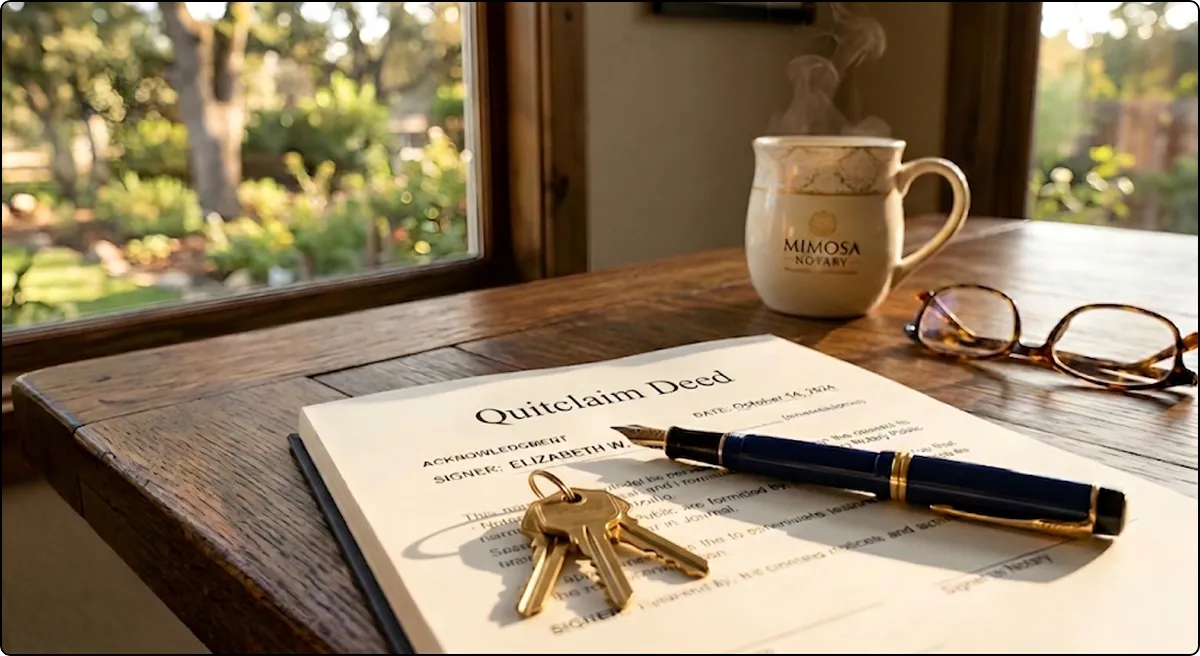
Who Can Notarize a Quitclaim Deed?
A quitclaim deed often gets signed during intensely emotional or high-stress family transitions—adding a spouse to a property title, removing an ex-spouse following a divorce, transferring a home into a family living trust, or settling an estate after a parent passes away. In those fast-moving moments, one practical question comes up fast: who can notarize a quitclaim deed? The short answer is any active, commissioned notary public. However, the real answer depends on strict state regulations, verification of the signer's identity, and whether the document is structurally prepared before the appointment begins.
Property transfers in California do not happen on a simple handshake. Real estate documents carry permanent legal and financial consequences. If an execution step is missed, the county recorder will flatly reject the filing, completely stalling your transition and potentially jeopardizing your property title.
I. Core Qualifications: Who is Authorized to Notarize a Deed?
Understanding who can legally execute a real estate document prevents severe chain-of-title defects from occurring later on the public record.
A. The General Jurisdiction Rules
1. Commissioned Authority Required: Only an active, state-commissioned notary public can administer the mandatory verbal acknowledgment and affix an official seal to a quitclaim deed.
2. Strict Regional Boundaries: If the property transfer takes place within California lines, the professional must hold an active commission from the California Secretary of State.
3. The Impartiality Prerequisite: A notary's core legal purpose is to serve as a completely neutral, third-party witness to the transaction.
B. Can a Family Member Notarize a Quitclaim Deed?
1. Financial Interest Prohibition: While California law does not categorically forbid a notary from notarizing for a relative, it strictly prohibits a notary from executing any document in which they have a direct financial or beneficial interest.
2. The Conflict of Interest Rule: Under California Government Code § 8224, if a notary is named as a grantor or grantee, or will receive an ownership stake via the quitclaim transfer, performing the notarization is an immediate misdemeanor.
3. Avoiding Future Litigation: Even if a relative has no financial stake in the house, using a family member as your notary creates an immediate vulnerability. If the transfer is ever disputed in probate or divorce court, opposing attorneys can easily target the family connection to allege fraud, bias, or undue influence. Hiring an independent, outside mobile notary eliminates this liability completely.
II. Strict Statutory Mandates for California Real Estate Signings
Deeds face a significantly higher level of state scrutiny and fraud-prevention tracking than standard business agreements.
A. The Mandatory Journal Thumbprint Requirement
1. Enforcing Government Code § 8206: Under California Government Code § 8206(a)(2)(G), a notary public is legally mandated to capture the physical right thumbprint of the signer in their official sequential journal for any deed conveying real property.
2. Anti-Fraud Security: If the right thumbprint is physically unavailable, the left thumb or any available finger must be used. This ink print acts as an unforgeable biometric security layer that permanently binds the signer to the transaction.
3. Remote Online Notarization (RON) Limitations: Because California state law strictly mandates this physical ink thumbprint in the journal for real property transfers, remote online video notarizations do not satisfy the recording criteria for local deeds. The signer must be physically present in a face-to-face setting with the notary.
B. The Proof of Execution Prohibition
1. No Subscribing Witnesses: For regular documents, if a signer cannot appear, a "Proof of Execution by Subscribing Witness" can sometimes be used.
2. The Absolute Real Estate Ban: For quitclaim deeds, grant deeds, and deeds of trust, this workaround is strictly prohibited by law. The primary owner (grantor) giving up their property interest must physically sit in front of the notary—no exceptions.
III. Identifying the Correct Parties and Document Readiness
A. Who Must Actually Sign the Deed?
1. The Grantor Hold: In a standard quitclaim transfer, only the Grantor (the individual giving up or transferring their current interest in the property) is legally required to sign the document in front of the notary.
2. The Grantee Exemption: The Grantee (the person or trust receiving the property interest) typically does not need to sign or have their identity verified at the appointment, unless the document contains specialized conditional signing brackets.
3. Verifying Identity Matches: The name printed on the quitclaim deed must match the name printed on the signer's valid government photo ID. If a mother is transferring her home to her living trust, her license must pass California’s strict 5-year issuance law.
B. Real Estate Document Completeness
1. Legal Description Field: A quitclaim deed must feature a completely filled-out, precise legal description of the real estate (metes and bounds, or lot and block data). Leaving this section blank or attaching it later introduces severe fraud liabilities and will cause an immediate cancellation.
2. Unsigned Presentation: Leave all signature lines entirely blank until the mobile notary is physically sitting with you at your location.
IV. Navigating the Post-Notarization Recording Process
A. The Notary Does Not Record the Document
1. A Distinct Final Step: Notarization simply completes the verification of the signature. It does not legally finalize the transfer of the home.
2. Local Filing Protocols: To make the ownership transfer official on the public record, the notarized deed must be manually or electronically submitted to the county recorder where the property physically resides.
3. Supplemental Filing Folders: When submitting a quitclaim deed to the San Joaquin County Recorder’s Office on E. Weber Avenue in downtown Stockton, you must also supply required supplemental state forms. This typically includes a Preliminary Change of Ownership Report (PCOR) and a Documentary Transfer Tax declaration. Missing these documents will result in the county rejecting your filing, even if your notary stamp is completely perfect.
Your Trusted Local Partner: Mimosa Notary
When coordinating a real estate title change or funding an estate plan across the Lodi, Stockton, Elk Grove, Galt, Tracy, and Manteca corridors, working with an experienced, independent mobile notary eliminates preventable recording errors. Whether you are finalizing a property transfer at your family kitchen table, an escrow office, an assisted living suite, or a local hospital bedside, having a precise professional manage the strict California journal markings brings peace of mind to a complicated day.
Mimosa Notary brings meticulous, supportive, and legally compliant mobile deed services directly to your location. We carefully verify credential issuance dates, securely capture the mandatory statutory thumbprints, and ensure your paperwork matches the rigorous demands of the county recorder.
Need to schedule an immediate mobile deed signing or lock in a priority travel slot? Click our "Schedule Your Appointment" button to secure your dispatch window instantly. If you are handling a complex family estate transfer or need quick structural clarification regarding your signing logistics first, click our "Complimentary Call" button to connect directly with our dispatch team. Let's ensure your property paperwork is executed with absolute legal precision!

Complimentary Call
We provide high-quality calls designed for clients who need a quick clarification before booking.

Meticulous Mobile Service Across San Joaquin,
Southern Sacramento,
Amador & Calaveras Counties
While our roots are in Lodi and Stockton, our Director of Logistics, Neil Lewis, coordinates mobile signings across a wide footprint to ensure we meet you wherever you are—at home, the office, or bedside.
Stockton
Lodi
Tracy
Manteca
Lathrop
Ripon
Ione
Brookside
Franklin
Escalon
Mountain House
Acampo
Linden
Lockeford
Woodbridge
Collierville
Morada
Clay
French Camp
Thornton
Clements
Victor
Farmington
Holt
Rancho Calaveras
Herald
Lincoln Village
Galt
Elk Grove
Rio Vista
Isleton
Walnut Grove
Valley Springs
Wallace
Wilton
Victor
Mimosa Notary:
Your Trusted Local Partner,
Specialized Mobile Notary &
Certified Loan Signing Agent.
Whether you have a quick question about a Power of Attorney or need an Urgent Hospital Bedside Signing or Standard Notary Services,
We are here to help.
Contact our team directly for a quote or to discuss your specific document needs.
Quick links
Services
Lodi, CA
📍 Primary Service Area:
Lodi, Stockton, Elk Grove, Galt, San Joaquin County and Surrounding Areas.
"Precision-Focused."
"Family-Oriented."
"Done Right the First Time."
Mimosa Notary is an Independently Owned & Operated Mobile Service.
Disclaimer:
Mimosa Notary is not a Law Office, and its employees are not acting as your attorney.
Mimosa Notary does not practice law and does not give legal advice.
This website is not a substitute for the legal advice of legal counsel.
© Mimosa Notary. 2026. All Rights Reserved.
Mimosa Notary is a trade name of Gregory Neil Lewis.
Service Areas: Lodi, Stockton, Galt, Elk Grove, San Joaquin County and Surrounding Areas.