
The San Joaquin Signpost
Providing Professional Guides on Power of Attorney,
Hospital Bedside Signings, and
Real Estate Transactions
Across San Joaquin County.
Notary for Living Trust Documents Explained: San Joaquin County Guide
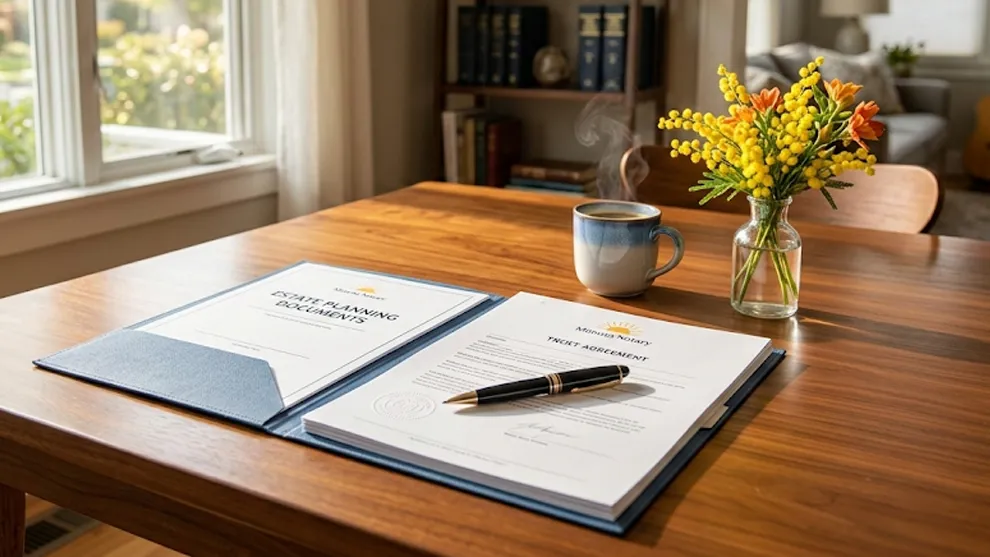
A living trust signing often starts at a kitchen table in a quiet neighborhood, not inside a high-rise law office. A parent has finally gathered the heavy estate planning folder, adult children are asking which lines need to be signed first, and someone inevitably asks whether hiring a mobile notary for living trust documents is actually a legal requirement. That question carries immense weight, because one single missed notarization or flawed certificate can trigger months of probate delays or recording rejections at exactly the moment a local family needs clarity.
The more comprehensive an estate plan is, the more moving parts it contains. A standard living trust package is rarely just a standalone document; it is a meticulously organized bundle of transfers, authorizations, and protections. Each independent page inside that folder can carry its own unique statutory signing standard under California law.
I. When a Notary for Living Trust Documents is Structurally Required
Understanding how California treats different pieces of an estate package prevents families from making critical execution errors before the mobile notary arrives.
A. Trust Execution Under California Standards
1. The Core Trust Document: Under California Probate Code § 15200, a trust can technically be created without a notary seal. However, California estate attorneys almost universally embed formal notary acknowledgment blocks at the end of the text.
2. The Fraud Protection Layer: Formal notarization establishes a permanent, legally verified record of identity. This makes it exceptionally difficult for disgruntled heirs to challenge the trust later by claiming the trust maker (settlor) was impersonated or signed under duress.
3. Trust Certifications: A Certification of Trust (a shorthand document shown to financial institutions to prove the trust exists without revealing private beneficiary asset distributions) explicitly requires formal notarization under California Probate Code § 18100.5 before banks will honor it.
B. Funding the Trust: Real Estate Deeds
1. The Transfer Requirement: Simply writing a house into a trust document does not mean the trust owns it. The property must be formally "funded" into the trust using a Grant Deed or Quitclaim Deed.
2. Mandatory Recording Mandates: For a deed to be accepted and recorded by the San Joaquin County Recorder’s Office on E. Weber Avenue in Stockton, the signature must be officially acknowledged before a commissioned notary public.
3. The Pour-Over Will Divergence: Your trust packet likely contains a "Pour-Over Will" designed to catch any forgotten assets. Unlike the deeds, a will in California does not require a notary stamp to be valid—it strictly demands the physical signatures of two completely disinterested witnesses.
II. The Boundaries of a Notary Public’s Legal Authority
A mobile notary public provides essential operational precision at your table, but state regulations draw a sharp line regarding what they can legally communicate.
A. What the Notary Professionally Executes
1. Identity Attestation: Verifying the signer's identity using original, physical government credentials under strict state timelines.
2. Voluntary Compliance Checks: Evaluating the signer's basic mental alertness and confirming they are executing the estate folder willingly.
3. Journal and Seal Management: Completing the mandatory sequential journal lines and stamping the exact statutory wording required for California acknowledgments and jurats.
B. Strict Legal Prohibitions
1. No Unauthorized Practice of Law (UPL): A notary public is strictly forbidden from providing legal advice. They cannot tell you how to fund your trust, explain the tax implications of a deed transfer, choose your beneficiaries, or advise you on which trustee should have priority power.
2. Pre-Appointment Resolutions: If your document contains typographical errors, missing pages, or confusing blank spaces, those legal issues must be cleared with your drafting attorney before your mobile notary dispatch window begins.
III. Avoidable Mistakes That Can Derail an Estate Signing
A. The Perils of Premature Signing
1. The Presence Rule: The principal must never sign or date any document requiring a notary acknowledgment ahead of time.
2. Real-Time Acknowledgment: The notary must physically witness the signature or take a direct, lawful verbal acknowledgment from the living signer in person. Pre-signed pages will result in an immediate refusal to notarize.
B. Navigating the Strict 5-Year ID Guidelines
1. Statutory Tracking: Per the California Secretary of State Notary Public Handbook, any identification card presented to a notary must be current or have been issued within the past 5 years.
2. The Audit Parameter: If an elderly parent is signing a trust at home or bedside and their driver's license was issued more than five years ago, the notarization cannot proceed, even if the expiration date printed on the front appears valid. Always verify the issuance date prior to the appointment.
C. Disregarding Capacity and Medication Windows
1. Cognitive Baseline Evaluation: For delicate bedside or living room signings, the principal must exhibit complete cognitive awareness of what they are executing.
2. Managing Medical Pacing: If a loved one is recovering from an illness or managing intense pain medication, coordinate the mobile notary arrival around their peak alertness window. If they are drifting, disoriented, or heavily sedated, the signing must legally be postponed.
IV. How to Prepare Your Location for a Mobile Trust Signing
A. Setting Up the Physical Workspace
1. Surface Requirements: Provide a large, flat, well-lit table surface (such as a dining room table or an office desk) to comfortably process thick multi-page estate packets and the notary's official sequential journal.
2. Minimize Local Distractions: Keep televisions muted, move family pets to another room, and clear the immediate area to ensure the principal can completely focus on the document review.
3. Assistive Devices Ready: Double-check that reading glasses, hearing aids, or adaptive signing grips are fully operational and in place before the notary arrives.
Your Trusted Local Partner: Mimosa Notary
When executing high-stakes estate documentation, taking systematic steps to verify page completeness, validate ID issuance dates under California law, and organize a distraction-free signing workspace is the fastest track to protecting your family's future.
Mimosa Notary serves families, corporate trustees, and estate planning professionals across the Lodi, Stockton, Elk Grove, Galt, Tracy, and Manteca corridors with the calm, methodical, and legally precise support these high-consequence files demand. We understand that an estate planning dispatch is more than just an administrative task—it is a critical family milestone that requires absolute compliance and meticulous care.
Need to book an immediate mobile trust signing or secure a priority time slot for your home or office? Click our "Schedule Your Appointment" button to lock in your dispatch window in seconds. If you have a unique document package or need quick structural clarification first, click our "Complimentary Call" button to connect directly with our dispatch team. Let’s ensure your legacy is protected with absolute legal precision!

Complimentary Call
We provide high-quality calls designed for clients who need a quick clarification before booking.

Meticulous Mobile Service Across San Joaquin,
Southern Sacramento,
Amador & Calaveras Counties
While our roots are in Lodi and Stockton, our Director of Logistics, Neil Lewis, coordinates mobile signings across a wide footprint to ensure we meet you wherever you are—at home, the office, or bedside.
Stockton
Lodi
Tracy
Manteca
Lathrop
Ripon
Ione
Brookside
Franklin
Escalon
Mountain House
Acampo
Linden
Lockeford
Woodbridge
Collierville
Morada
Clay
French Camp
Thornton
Clements
Victor
Farmington
Holt
Rancho Calaveras
Herald
Lincoln Village
Galt
Elk Grove
Rio Vista
Isleton
Walnut Grove
Valley Springs
Wallace
Wilton
Victor
Mimosa Notary:
Your Trusted Local Partner,
Specialized Mobile Notary &
Certified Loan Signing Agent.
Whether you have a quick question about a Power of Attorney or need an Urgent Hospital Bedside Signing or Standard Notary Services,
We are here to help.
Contact our team directly for a quote or to discuss your specific document needs.
Quick links
Services
Lodi, CA
📍 Primary Service Area:
Lodi, Stockton, Elk Grove, Galt, San Joaquin County and Surrounding Areas.
"Precision-Focused."
"Family-Oriented."
"Done Right the First Time."
Mimosa Notary is an Independently Owned & Operated Mobile Service.
Disclaimer:
Mimosa Notary is not a Law Office, and its employees are not acting as your attorney.
Mimosa Notary does not practice law and does not give legal advice.
This website is not a substitute for the legal advice of legal counsel.
© Mimosa Notary. 2026. All Rights Reserved.
Mimosa Notary is a trade name of Gregory Neil Lewis.
Service Areas: Lodi, Stockton, Galt, Elk Grove, San Joaquin County and Surrounding Areas.