Mobile Notary for Nursing Home Residents (San Joaquin County Guide)
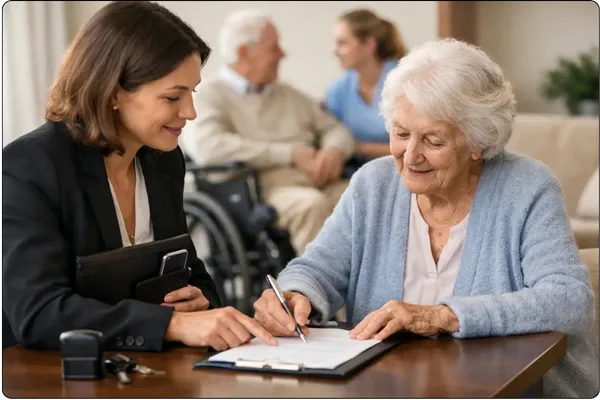
A daughter gets an urgent call from the care team along the Pacific Avenue commercial corridor in Stockton or near W. Kettleman Lane in Lodi. Her mother is medically stable, but the legal paperwork simply cannot wait another day. A critical power of attorney needs to be executed, and arranging medical transport to a traditional office setting is physically unrealistic. That is exactly when a mobile notary for nursing home residents transforms from a simple convenience into a vital lifeline—providing a practical way to protect essential decisions without adding more physical or emotional strain to your family.
In nursing homes, rehabilitation suites, and skilled care settings across San Joaquin County, timing dictates everything. Families are routinely handling active physician updates, complex insurance approvals, facility check-in requirements, and profound personal stress all at once. Important legal assets must be signed flawlessly; a minor clerical error or a missed signature field can result in immediate rejection by a banking compliance team or healthcare provider at the worst possible moment. A specialized mobile notary public brings a protective, controlled framework straight to the resident's bedside, ensuring a smooth, fully compliant execution.
I. Capacity, Awareness, and Peak Timing Windows
One of the most delicate challenges during a care facility visit is navigating the strict legal definitions of cognitive competence required for a valid notarization.
A. The Alertness Standard at the Bedside
1. Real-Time Interaction Mandatory: Under guidelines managed by the California Secretary of State Notary Public Division, a mobile notary must interact directly and independently with the resident. The signer must be lucid enough at the exact moment of execution to understand the basic nature, purpose, and long-term consequences of the form they are signing.
2. Tracking Medication Cycles: Cognitive clarity can fluctuate intensely throughout a single afternoon. Work closely with the floor charge nurse to pin down your parent's daily peak mental clarity window—often shortly after a morning meal or right before their next heavy pain management cycle.
3. Non-Responsive Prohibitions: If a parent is heavily sedated, deeply asleep, non-communicative, or experiencing advanced cognitive decline where they cannot verify their name or intent, the session cannot legally proceed. A notary cannot rely on a relative's or a doctor's verbal assurance of intent.
B. Protection from Family Coercion
1. Voluntary Consent Verification: The notary must verify that the resident is signing entirely of their own free will.
2. Mandatory Room Clearances: If family members crowd the bed, talk over the resident, or point to lines aggressively, a seasoned mobile notary will politely ask everyone to step into the hallway for a few moments to conduct a confidential, private capacity screening. This protects your loved one under strict elder consumer-safety guidelines.
II. Overcoming Identification Hurdles inside the Facility
Securing valid physical credentials is the single largest procedural roadblock families face when arranging a mobile signing inside local nursing homes.
A. The Strict California 5-Year ID Law
1. Auditing Issuance Dates: Per California Civil Code § 1185, any identification card presented to a notary must be current or have been issued within the past 5 years.
2. The Expired Senior Trap: It is incredibly common for long-term residents to let their driver's licenses lapse once they stop driving. While an old plastic ID or a facility patient wristband may be acceptable for checking into a medical wing, they are legally invalid for a notarization if the issuance date is older than 5 years.
B. The Credible Witness Alternative
1. Swearing to Identity Under Oath: If your parent's ID was lost during an emergency transfer or is permanently expired, California allows identity to be established using two credible witnesses.
2. Strict Disinterested Status: Pursuant to Civil Code § 1185, these two witnesses must physically stand at the bedside with the notary, display their own unexpired government-issued photo IDs, and cannot hold any financial or medical interest in the folders being signed. They cannot be named as a trustee, an agent, an heir, or a beneficiary anywhere within the estate binder.
III. Document Integrity and the Skilled Nursing Facility Ombudsman Rule
A. Mandatory Journal Thumbprint Tracking
1. Enforcing Government Code § 8206: Under California Government Code § 8206(a)(2)(G), if the document being executed is a financial Power of Attorney or a real estate deed, the signer must place their physical right thumbprint into the notary's official sequential journal. This requires face-to-face proximity, making remote video notarization completely unavailable for these files.
2. Keeping Text Intact: The document must be structurally complete before the stamp is applied. A notary cannot process a deed or a power of attorney that contains unresolved blank spaces or missing asset descriptions. Leave signature lines entirely blank until the notary is present.
B. The Skilled Nursing Facility (SNF) Ombudsman Mandate
1. Enforcing Probate Code § 4675: If your loved one is currently a patient inside a licensed skilled nursing facility—such as Arbor Nursing Center in Lodi, Wagner Heights Nursing Rehabilitation in Stockton, or local long-term care beds in Manteca—and needs to sign an Advance Healthcare Directive, California law dictates that a Long-Term Care Ombudsman must be physically present to witness the event.
2. Prior Coordination Required: Under California Probate Code § 4675, the healthcare directive is completely ineffective unless a state-designated Patient Advocate signs the document alongside the notary. You must contact the facility’s social services department several days in advance to request an Ombudsman dispatch.
Your Trusted Local Partner: Mimosa Notary
Executing high-consequence medical and financial protections within a nursing home or sub-acute facility is rarely a casual transaction. It requires a provider who moves with immense patience, deep empathy, and absolute legal precision.
Mimosa Notary specializes in bringing compassionate, highly compliant mobile notary services directly to private homes, senior living communities, and clinical bedsides across the Lodi, Stockton, Elk Grove, Galt, Tracy, and Manteca corridors. We understand the pacing of nurse rotations, the nuances of room access, and the absolute strictness of California's biometric journal and identity verification laws. We protect your family's legacy while preserving the complete comfort and dignity of your loved one.
Need to lock in an immediate mobile appointment or secure a priority facility time slot? Click our "Schedule Your Appointment" button to claim your dispatch window instantly. If you are navigating an expired credential challenge or need a quick procedural question answered first, click our "Complimentary Call" button to connect directly with our dispatch team. Let's ensure your family protections are executed with absolute legal precision!