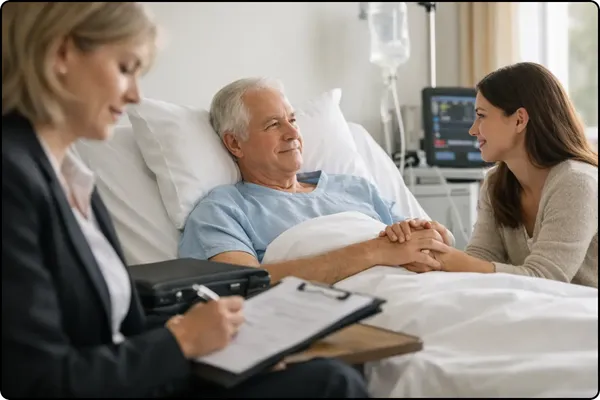
Can a Notary Come to the Hospital? A Bedside Guide for San Joaquin County
A family member is being unexpectedly admitted, legal paperwork suddenly matters, and the question gets urgent fast: can a notary come to the hospital? In almost all cases across California, the answer is yes. A professional mobile notary can travel directly to a hospital room, rehabilitation wing, or intensive care center to notarize qualifying documents, but the bedside signing must still strictly align with rigorous legal and medical requirements. The principal signer must be completely willing, mentally aware, capable of communicating intent, and able to present a valid form of identification.
That threshold is the exact part local families often do not hear until they are already under immense emotional pressure. While a traveling mobile notary brings incredible convenience to a stressful environment, a notary has absolutely zero legal authority to override statutory capacity rules, hospital visitation restrictions, or incomplete paperwork packages. Understanding what makes a hospital notarization legally viable can save your family precious time and prevent a painful, last-minute cancellation at the bedside.
I. Checking Document Preparation Rules Inside a Healthcare Facility
Not every document that arrives at a patient's bedside requires a notary stamp, and not every packet brought to a hospital room is immediately ready for execution.
A. Evaluating What Documents Require a Notary Seal
1. Core Hospital Requests: The majority of urgent mobile notary requests involve a Durable Power of Attorney for finances, an Advance Healthcare Directive, localized estate planning packages, real estate deeds, or time-sensitive corporate affidavits tied to an unexpected medical emergency.
2. The Witness vs. Notary Threshold: The first vital step is verifying your document's exact execution lines. Some state forms require independent witnesses, some demand a notary public acknowledgment, and others require both.
3. Execution Restrictions: Under California notary laws, a notary public can verify identity and execute the notarial certificate, but they are strictly prohibited from selecting the form for you, explaining the legal consequences of the document, or providing document interpretation.
B. Managing Text Completeness and Blank Fields
1. The Threat of Blank Spaces: For high-consequence files, the paperwork must be fully drafted and completed before the notary arrives. Presenting a legal document with significant blank spaces introduces severe fraud risks, forcing the notary to legally pause the appointment.
2. The Unsigned Presence Rule: The document must remain completely unsigned and undated. The notary must physically witness the principal execute the signature line in real time during the face-to-face appointment.
II. Evaluating the Signer's Awareness, Willingness, and Legal Capacity
A hospital signing works best when the patient is naturally alert, comfortable, and capable of understanding the document they are executing.
A. The Strict Baseline of Cognitive Consent
1. Independent Communication: The patient must be mentally present enough to grasp what the document does and communicate that understanding directly to the notary.
2. Assessing Voluntary Action: The mobile notary must be completely satisfied that the signer is acting entirely of their own free will and is not being coerced, rushed, or pressured by over-anxious family members or facility caregivers standing in the room.
3. The Reality of Fluctuating Alertness: It is common for a patient to have clear moments in the morning and experience deep fatigue or disorientation later in the day due to medication or treatment cycles. If a family member notes that a patient has "good and bad hours," the appointment must be carefully scheduled around those peak alertness windows.
B. Physical Weakness vs. Mental Competence
1. Shaky Signatures Are Permitted: A patient does not need to possess physical strength to execute a document. A slow, shaky signature, or an execution assisted by paper-positioning tools, is legally acceptable.
2. Signature by Mark: If a patient is physically unable to write their name due to injury or medical lines, California allows a "Signature by Mark," provided specific physical witness rules are met at the bedside.
3. Privacy Clearances: To protect the transaction, a professional notary may ask family members to briefly step out of the room to conduct a private capacity evaluation with the patient. This is standard legal compliance, not a sign of suspicion.
III. Overcoming Identification Hurdles in a Hospital Environment
Medical environments do not waive state identity requirements. Failing to secure the correct physical credentials before the notary arrives is the primary reason hospital signings fall through.
A. Valid vs. Invalid Healthcare Identifiers
1. Hospital Wristbands Are Invalid: A patient's plastic medical bracelet or verbal verification from an attending physician or nurse never constitutes lawful identification for a notary public.
2. The Statutory Rule: Per California Civil Code § 1185 and the official guidelines outlined in the California Secretary of State Notary Public Handbook, the signer must display a physical identification credential that is either current or was issued within the past 5 years.
B. Handling Lost or Unavailable Identification
1. Credible Witnesses: If a patient’s ID was lost during an emergency admission or has been expired past the 5-year window, California permits the use of two credible witnesses to swear to the signer’s identity under penalty of perjury.
2. Credible Witness Rules: These witnesses must be personally known to the patient, must possess their own valid government photo IDs, and cannot be named as an agent, heir, or beneficiary anywhere within the documents being signed.
IV. Can a Notary Come to the Hospital for a Power of Attorney?
Yes, executing a Durable Power of Attorney (POA) is one of the most common reasons local families require urgent mobile notary dispatch.
A. The Capacity Catch-22
1. The Core Misunderstanding: A family often realizes they desperately need a financial POA because a loved one's health or cognitive baseline is rapidly declining.
2. The Legal Cutoff: However, under California Probate Code § 4121, a POA is only legally sufficient if the principal possesses the full legal capacity to contract at the exact second they sign. Once a patient loses the ability to comprehend the document due to advanced dementia, heavy sedation, or an uncommunicative state, they can no longer sign a new POA. At that stage, the family must consult an attorney regarding a court-supervised conservatorship.
V. Navigating San Joaquin County Hospital Logistics
Bedside notarizations inside major regional medical complexes require a provider who understands specialized facility navigation, visitor limits, and intensive care access rules.
A. Coordinating Local Facility Clearances
1. Know Your Unit Rules: Intensive Care Units (ICU), cardiac recovery wings, and secure memory care units maintain strict, unit-specific visitor caps and specialized infection control protocols.
2. Major Regional Touchpoints: Whether navigating the patient wings at St. Joseph's Medical Center on N. California Street in Stockton, Dameron Hospital near downtown, Kaiser Permanente Manteca, or Adventist Health Lodi Memorial on S. Fairmont Avenue, confirming exact floor locations and building towers beforehand ensures an accurate arrival.
3. Avoid Staff Assumptions: Never assume on-duty hospital nurses or social workers can step away from patient care to act as legal witnesses. If your paperwork dictates independent witnesses, those individuals must be arranged and present alongside the mobile notary.
Your Trusted Local Partner: Mimosa Notary
When a critical legal, real estate, or medical document becomes urgent during a hospital stay, taking careful, structured steps to ensure document readiness, ID validation under California's 5-year rule, and proper timing around medication rounds is the fastest path to a successful signing.
Mimosa Notary specializes in bringing calm, meticulous, and legally precise mobile services directly to patient bedsides, assisted living communities, and family homes across the Lodi, Stockton, Manteca, Tracy, and broader San Joaquin County corridors. We understand how to coordinate seamlessly around complex treatment schedules, ensuring your family's critical high-stakes signings are executed with absolute care and statutory compliance.
Need to schedule an immediate hospital dispatch or secure a priority bedside time slot? Click our "Schedule Your Appointment" button to lock in your mobile window in seconds. If you are dealing with a complex medical scenario or need a quick procedural clarification first, click our "Complimentary Call" button to connect directly with our dispatch team. Let's ensure your legal paperwork is handled with absolute precision!