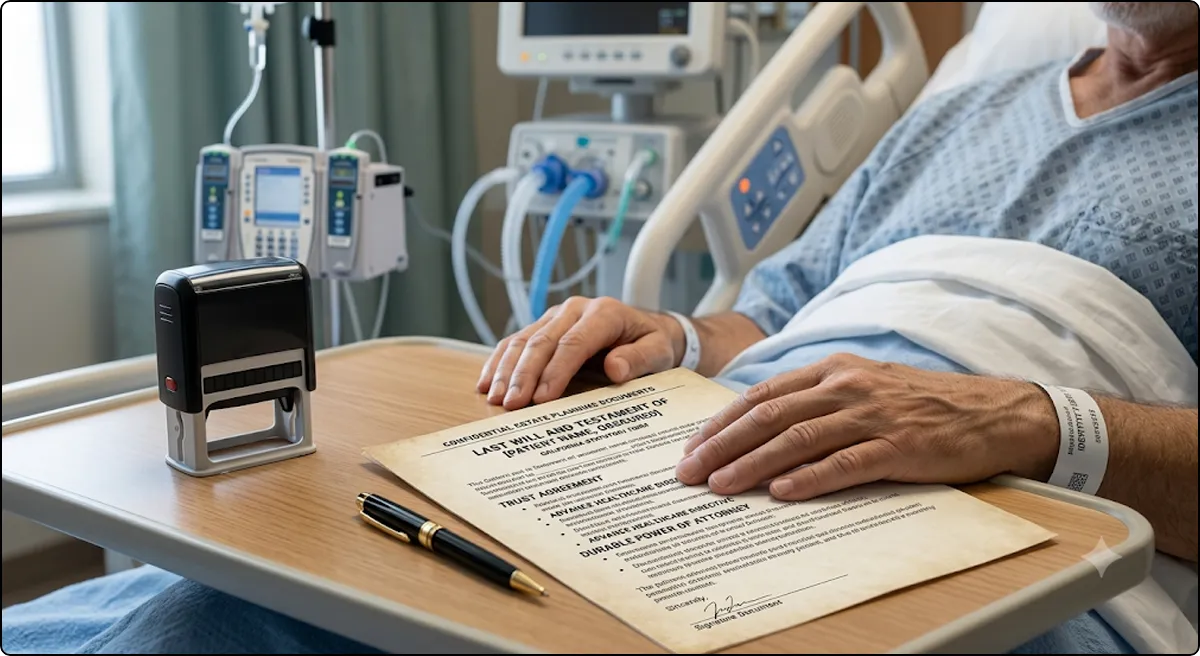
Advance Healthcare Directive Notary Near Me: A Guide to San Joaquin & Sacramento Counties
A hospital room or a fast-moving home transition is not where most local families expect to be sorting out legal signatures, identification rules, and witness mandates. Yet, that is often exactly when people frantically type "advance healthcare directive notary near me" into a search bar—during an unexpected health scare, right after a critical diagnosis, or when an aging parent wants their medical wishes clearly documented before a crisis worsens.
That urgent search usually comes with high emotional stress and deep uncertainty. Families need to know whether an Advance Directive strictly requires a California notary seal, whether a mobile notary can legally enter local intensive care units or memory care facilities, and what preventable mistakes could halt a signing right when time matters most.
I. When an Advance Healthcare Directive Requires a Notary Public
An Advance Healthcare Directive lets an individual explicitly state their future medical choices and designate a healthcare proxy (agent) to make decisions if they lose cognitive or communicative capacity.
A. Execution Under California Frameworks
1. Independent Signings: Many residents complete these forms independently following a hospital stay, a chronic diagnosis, or an intimate family planning session.
2. The Legal Divergence: Under California Probate Code § 4701, the document is only legally executed if it is either acknowledged before a notary public or signed by at least two qualified, physical witnesses.
3. Clearing the Witness Confusion: Some families mistakenly assume they need both witnesses and a notary, while others bring relatives who are legally disqualified from witnessing. A mobile notary can seamlessly administer the official oath and log the journal entry, but cannot legally dictate which execution track your family should choose.
B. Pre-Arrival Document Preparation
1. Maintain Blanks for Signatures: The document text must be completely filled out and reviewed, but the signature lines must remain entirely blank.
2. Mandatory Face-to-Face Appearance: Under California notary mandates, the principal must physically sign the page directly in front of the mobile notary. Pre-signed forms cannot be legally notarized and will force a cancellation.
II. The Practical Role of a Hospital Bedside Mobile Notary
In emotionally delicate healthcare situations, a traveling notary public provides essential operational precision when a principal cannot travel to a physical office.
A. Bringing Service Directly to the Signer
1. Eliminating Transport Risks: Signers are frequently recovering at home, resting in an assisted living wing, or confined to a local rehabilitation bed where transport is physically impossible or medically dangerous.
2. Managing Complex Logistics: A mobile signing allows adult children commuting along the I-5 or Highway 99 corridors, out-of-town relatives, and busy medical staff to execute documents efficiently without disruptive scheduling delays.
B. Enforcing Strict Notarial Guardrails
1. No Document Selection: A notary public cannot draft the text, alter the healthcare instructions, or advise you on which medical treatment options to check.
2. Assessing Voluntary Intent: The notary's sole legal role is to physically verify identity using unexpired government credentials, assess basic cognitive alertness, and confirm the principal is signing of their own free will without family coercion.
3. Legal Capacity Thresholds: If a patient is completely unconscious, heavily sedated, non-responsive, or unable to communicate basic intent, a notary cannot legally proceed—even if the entire family and medical team are in absolute agreement.
III. Avoidable Mistakes That Cause Bedside Notary Delays
A. Violating the California 5-Year ID Law
1. The Statutory Rule: Per California Civil Code § 1185, any driver's license, state ID, or passport presented to the notary must be current or have been issued within the past 5 years.
2. Check the Issuance Date: Waiting until the notary arrives at a facility like San Joaquin General Hospital to discover a patient's license is expired or missing an active issuance date is the primary cause of failed signings.
B. Misunderstanding the Skilled Nursing Facility Ombudsman Mandate
1. The SNF Witness Rule: Under California Probate Code § 4675, if an Advance Directive is signed inside a skilled nursing facility, it is legally invalid unless a designated Patient Advocate or Long-Term Care Ombudsman is physically present to witness and sign the document.
2. Coordination Burden: A mobile notary cannot waive or bypass this statutory rule. Families must coordinate directly with the facility's social services director to schedule an approved Ombudsman to be at the bedside during the notary's dispatch window.
IV. How to Prepare Your Environment for a Mobile Notary
A. Optimizing the Physical Location
1. Clear the Workspace: Ensure there is a stable table surface or a cleared bedside tray table ready for the document journal entries.
2. Access Credentials Ready: If the notary is traveling to a secure regional campus—such as Adventist Health Lodi Memorial, St. Joseph's Medical Center in Stockton, or Kaiser Permanente Manteca—confirm the exact room number, bed number, and facility visitor check-in rules in advance.
3. Coordinate Around Care Pacing: Time the dispatch window for when the patient is naturally at their highest baseline of mental alertness, explicitly avoiding times immediately following heavy medication rounds or during scheduled doctor rotations.
Why Local Coordination Matters: Mimosa Notary
When searching for an advance healthcare directive notary near me, true local expertise means more than just a fast travel time. It means working with a provider who intimately understands the regional layouts, secure parking rules, and facility check-in protocols across Lodi, Stockton, Galt, Elk Grove, Tracy, and Manteca.
Mimosa Notary specializes in bringing calm, methodical, and legally precise bedside services directly to families navigating high-stress medical and estate transitions throughout San Joaquin County and surrounding corridors. We help you double-check document readiness, verify ID compliance early, and handle your high-stakes signings with absolute care and statutory precision.
Need to lock in an immediate bedside dispatch or priority mobile slot? Click our "Schedule Your Appointment" button to secure your mobile window instantly. If you are dealing with a complex hospital scenario or need a quick procedural question answered first, click our "Complimentary Call" button to connect directly with our dispatch team. Let's ensure your medical wishes are protected with absolute legal precision!